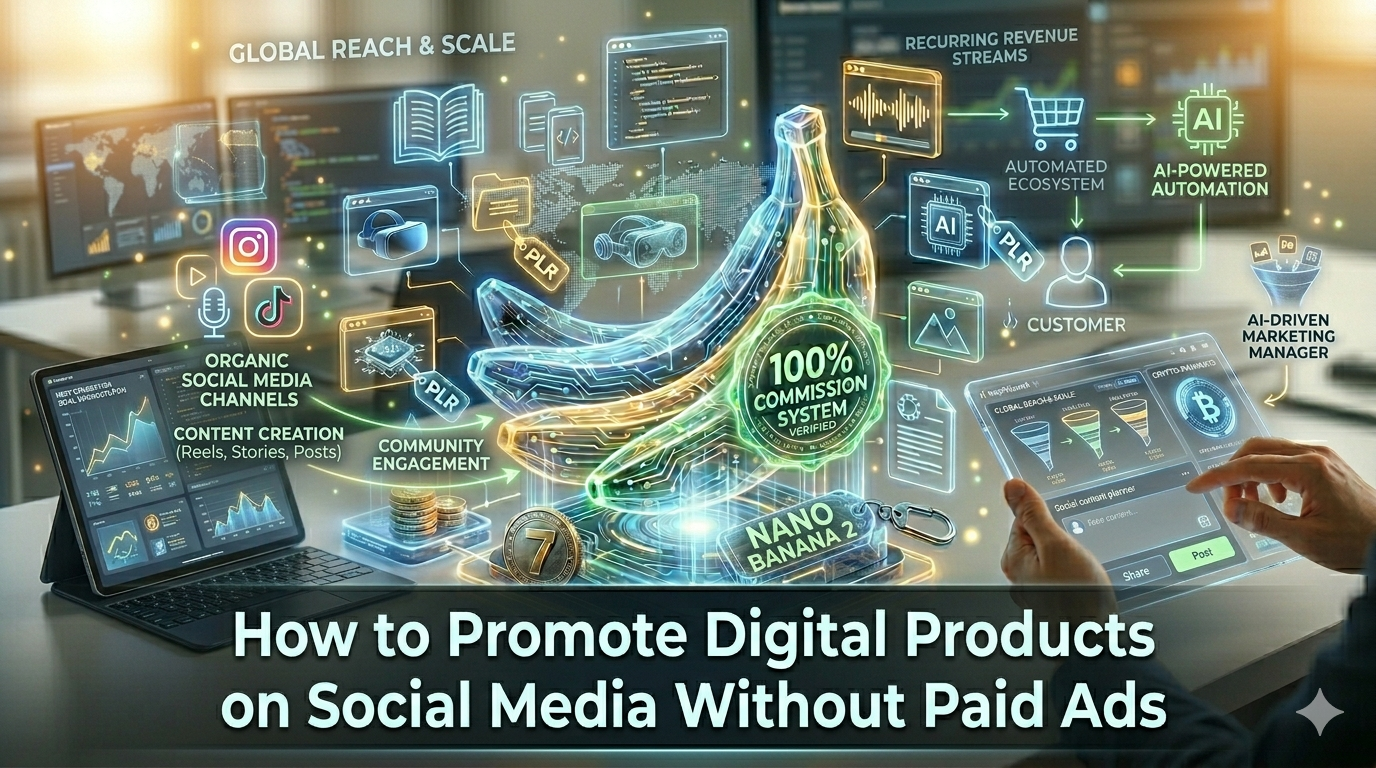
Want to know how to promote digital products on social media without paid ads? Discover the exact free traffic strategies that drive real clicks and commissions to your digital product affiliate links — no ad budget required.
Introduction
Here’s something that doesn’t get said nearly enough in the affiliate marketing space — the people spending the most money on Facebook ads are very often making less profit than the people spending nothing. I know that sounds backwards. But when you factor in testing costs, failed campaigns, learning curves, and the constant reality that ad performance degrades over time and requires ongoing investment to maintain, the return on paid advertising for beginners promoting digital products is often deeply negative.
I found this out the hard way. Spent close to $400 in my first three months on Facebook ads that generated almost nothing — a handful of clicks, zero conversions, and a growing suspicion that I was missing something fundamental. The thing I was missing turned out to be embarrassingly simple. The people making real money promoting digital products on social media weren’t running ads at all. They were posting. Genuinely, authentically, consistently posting on platforms they were already on — and the traffic they were generating was not only free, it was converting better than anything I’d managed with a paid budget.
Free social media traffic is the most underestimated asset in affiliate marketing right now. In 2026, with organic reach tools more powerful than ever, authenticity rewarded more explicitly by every major algorithm, and audiences increasingly resistant to paid advertising, the case for free traffic over paid advertising for digital product promotion has never been stronger. And the best part? You already have everything you need to start. A social media account, a genuine story, and a proven digital product to promote.
In this article I’m going to walk you through exactly how to promote digital products on social media without spending a cent on ads — platform by platform, strategy by strategy, with the specific approaches that drive real clicks and real commissions. Let’s go.
 Click here to get your MegaLink for $7 and start promoting digital products on social media for free today
Why Free Social Media Traffic Beats Paid Ads for Beginner Digital Product Promotion
Before we get into the specific platforms and strategies, I want to make the case for free traffic properly — because I’ve met a lot of beginners who’ve been told that paid ads are the “real” way to scale and that free traffic is for people who can’t afford to do it properly. That framing is backwards and it costs beginners a lot of money they don’t have.
The hidden costs of paid advertising go well beyond the ad spend itself. To run profitable paid ads for digital product affiliate links, you need to understand audience targeting, creative testing, conversion tracking, retargeting, budget optimisation, and a dozen other skills that take months to develop and money to learn. Every campaign you run while you’re still learning is essentially paying for an education — an expensive education with no guarantee of graduation. Most beginners who try paid ads lose money for three to six months before they develop the skills to break even, let alone profit. That’s not a path to building income — that’s a path to burning through savings while convincing yourself you’re building a business.
Free social media traffic, by contrast, builds lasting assets rather than rented attention. When you run a paid ad, it exists for as long as you pay for it and disappears the moment you stop. When you create a genuine piece of content on social media — a post that resonates, a video that gets shared, a comment that starts a real conversation — that content continues existing and generating traffic long after you created it. The audience relationships you build through organic social media are yours. The email list you might eventually build from your organic traffic is yours. Paid advertising builds nothing that belongs to you the moment you turn off the tap.
Organic content converts better for digital products specifically because of the trust factor. When someone sees a paid ad for an online income system, their guard goes up immediately. They’ve seen a thousand variations of that ad before and they’re sceptical by default. When the same person sees a genuine post from someone in their network sharing their real experience with a system — including the doubts they had at the start and the specific results they’ve seen — that’s a fundamentally different psychological encounter. Authenticity disarms the scepticism that paid advertising triggers. And for digital products, which require trust before purchase, that difference in starting position translates directly into higher conversion rates.
The compounding advantage of free traffic is the long-term argument that makes the whole model so compelling. Paid traffic is linear — spend more, get more; spend nothing, get nothing. Free traffic compounds — each piece of content adds to the body of work driving traffic to your link, each relationship adds to the audience amplifying your reach, each commission result adds to the social proof powering your future conversions. Month twelve of consistent free traffic activity delivers dramatically more results than month one without proportionally more effort. That compounding effect is simply not available through paid advertising.
Choosing the Right Social Media Platform for Your Digital Product Promotion
One of the most common mistakes I see beginners make with free social media traffic is trying to be everywhere at once. They sign up for Facebook, TikTok, Instagram, YouTube, LinkedIn, and Pinterest simultaneously, produce thin mediocre content on all of them, and burn out within three weeks without gaining meaningful traction anywhere. The antidote is focus — one platform, done properly, for long enough to build real momentum.
Facebook remains the most powerful free traffic platform for digital product promotion in 2026 and it’s where I’d tell virtually every beginner to start. The combination of personal profiles, groups, and genuine human-to-human connection makes it uniquely suited to the trust-based selling that digital products require. Facebook’s user base skews toward the demographic most actively searching for online income solutions — people in their thirties, forties, and fifties who are motivated to change their financial situation and receptive to genuine personal recommendations. If you’re promoting a beginner-friendly digital product system like MegaLink, your ideal audience is already on Facebook in enormous numbers.
TikTok offers something that no other platform can match for new accounts — genuine organic reach from a standing start. On Facebook, a brand new profile with zero followers gets minimal reach on its posts. On TikTok, a brand new account with zero followers can post a video that reaches ten thousand people if the algorithm decides it’s engaging. For beginners willing to create short video content, TikTok represents the fastest possible route to organic visibility. The audience skews younger than Facebook, but the interest in online income and digital side hustles is genuinely strong across all age demographics on the platform.
Instagram Reels operates on a similar organic reach principle to TikTok for video content, with the added advantage of a more established presence in the aspirational lifestyle and online business spaces. Instagram’s visual nature makes it particularly effective for showing results — commission screenshots, lifestyle shots, behind-the-scenes glimpses of working the system — in ways that resonate emotionally with an audience thinking about their own financial goals.
YouTube is the platform I’d prioritise second after getting established on your primary platform — not because of its immediate reach potential, which is lower than TikTok or Facebook, but because of its long-term passive traffic value. A well-targeted YouTube video can drive consistent traffic to your affiliate link for months or years after upload. No other free traffic source has the same combination of search intent (people actively searching for what you’re offering) and longevity (content that stays indexed and discoverable indefinitely).
LinkedIn is the most underrated platform for digital product promotion in the entire social media landscape right now and I genuinely don’t understand why more affiliates aren’t using it. LinkedIn’s user base is professionals who are actively thinking about their career growth, income improvement, and side income opportunities. The organic reach on LinkedIn in 2026 is significantly better than Facebook for personal content. And the trust level of LinkedIn connections is higher than most other platforms because of the professional context. If your digital product relates to online income, professional development, or digital skills — which MegaLink absolutely does — LinkedIn deserves a serious look.
The framework for choosing your starting platform is simple. Go where you’re already most comfortable and most active. The best platform is the one you’ll actually use consistently. Don’t let perfect be the enemy of started. Pick one, focus, and build.
Facebook Strategies That Drive Real Clicks to Your Digital Product Links
Facebook is where most beginners should start their free traffic journey, so let me go deep on the specific strategies that actually work — not the generic “post valuable content” advice you’ll find everywhere, but the specific approaches that generate genuine clicks and conversions for digital product affiliate links.
Profile optimisation is the first step that most people skip entirely and then wonder why nobody’s clicking their links. Your Facebook profile is your landing page before the landing page. When someone sees your post and considers clicking your link, the first thing they do is check your profile. A blank profile with no photo, no bio, and no visible personality tells them nothing trustworthy. An optimised profile with a real photo, a bio that mentions your online income journey, a featured post linking to your MegaLink, and a history of genuine human activity tells them you’re a real person worth trusting. Spend thirty minutes on your profile before you make your first post. It matters more than most people realise.
Facebook groups are the single most powerful free traffic engine available for digital product promotion in 2026. Groups focused on making money online, work from home opportunities, side hustles, affiliate marketing, and digital business are full of people who are actively looking for exactly what you’re promoting. The strategy is not to join and immediately drop your affiliate link — that approach gets you removed from groups faster than you can say “spam.” The strategy is to join, spend the first week reading and commenting genuinely, add real value through helpful responses to questions people are already asking, build some recognition as a genuine helpful presence, and then introduce your own experience and link naturally as part of a real conversation. This approach takes slightly longer to generate the first click but produces dramatically better conversion rates because it’s built on genuine trust rather than cold promotion.
The exact post types that generate the most engagement and clicks for digital product affiliate links on Facebook are almost always story-based rather than feature-based. A post that says “This system pays 100% commissions on $7 products — click my link” is a feature-based post. It tells people what the product does. A post that says “Three months ago I was in exactly the position you might be in right now — sceptical, a bit broke, and desperate to find something that actually worked. Here’s what happened when I gave MegaLink a genuine 30 days” is a story-based post. It creates emotional identification, builds credibility through honesty, and generates genuine curiosity that drives clicks. Your personal journey — including the doubts and the slow start and the first commission — is your most powerful marketing asset on Facebook. Use it.
Consistency on Facebook is more important than frequency. Posting twice a day for two weeks then disappearing for a month is dramatically less effective than posting three to four times a week every single week without exception. The Facebook algorithm rewards consistent accounts with better reach over time. Your audience builds familiarity and trust with consistent posters. And your own skills — at writing posts, at telling your story, at identifying what resonates with your audience — improve meaningfully with consistent practice. Set a realistic posting schedule and protect it.
Short-Form Video Strategies for TikTok and Instagram Reels
Short-form video is the highest organic reach channel available to a new account in 2026 and it is genuinely underused by the affiliate marketing community. Most people who are promoting digital products online are still primarily text-based — Facebook posts, comments, written content. That means the short-form video space for digital product promotion is less saturated than most, and the algorithms on TikTok and Instagram actively want to distribute new content to new audiences. That’s an opportunity that won’t exist at this level forever.
The anatomy of a high-converting digital product short video has three components. An opening hook in the first two seconds that stops the scroll — a surprising statement, a counter-intuitive question, or a result that creates immediate curiosity. A middle section of thirty to forty-five seconds that delivers genuine value or tells a genuine story — your real experience with the system, a specific result you or someone else achieved, a single practical tip that’s immediately useful. And a closing call to action that’s direct but not pushy — “Link in bio if you want to see exactly how I did this” or “Drop a comment and I’ll send you the details” works better than “Buy now through my link.”
What to actually say in your digital product short videos is simpler than most beginners expect. Talk about your journey. Show a commission notification. React to a result from a live coaching session. Answer a specific question you’ve seen asked repeatedly in online income groups. Explain one specific thing you learned from the MegaLink training that surprised you. You don’t need a script, a ring light, or a professional setup. You need a phone, decent natural light, and the willingness to speak genuinely about something you’ve actually experienced. Authenticity consistently outperforms production value on both TikTok and Instagram Reels. The algorithm rewards watch time and engagement — and genuine, relatable content drives both far better than polished promotional videos.
Posting frequency for short-form video is one area where volume genuinely matters more than on text-based platforms. Three to five short videos per week on TikTok or Reels gives the algorithm enough material to identify what works for your account and start distributing it more broadly. Don’t obsess over individual video performance especially in the first month. Volume and consistency are what build traction. One video at a time, three to five times a week, for sixty to ninety days. By the end of that period, you’ll have a body of work, a growing audience, and a clear sense of what types of content resonate most with the people you’re trying to reach.
YouTube — Building a Long-Term Free Traffic Asset for Digital Products
If free social media traffic is the smart play for digital product promotion, YouTube is the smartest long-term investment within that category. While Facebook posts have a lifespan measured in hours and TikTok videos fade from active distribution within days or weeks, a YouTube video optimised around a specific search term can drive consistent, targeted traffic to your affiliate link for months or years after you upload it. That longevity is what makes YouTube the ultimate passive free traffic asset.
The types of videos that rank on YouTube and drive meaningful affiliate clicks for digital products fall into a few consistent categories. Review videos — “MegaLink Review: Is the $7 OLSP System Worth It?” — target people who are actively in the buying decision stage and searching for honest assessments before they commit. How-to videos — “How to Get Your First Commission With MegaLink Step by Step” — target people who have already joined and are looking for guidance, or people at the research stage who want to understand exactly what they’d be doing. Comparison videos — “MegaLink vs Other Beginner Affiliate Programs: Which Pays More?” — capture people comparing options and typically convert exceptionally well because the viewer has high intent and is close to a decision.
Creating a basic YouTube video with no professional equipment is completely achievable in 2026. Your phone camera is sufficient. Natural window light is sufficient. A quiet room is sufficient. What matters far more than production quality is whether your video answers the question the viewer came with, whether you come across as genuine and trustworthy, and whether your call to action is clear and natural. A rambling ten-minute video shot on a professional camera will underperform a clear, honest, seven-minute video shot on a phone every single time.
Basic YouTube SEO for digital product videos comes down to three things. Your video title should include the exact phrase people are searching — “MegaLink Review 2026” or “How to Make Money With Done-For-You Digital Products” — in a natural, readable format. Your video description should include your affiliate link in the first two lines, a brief summary of what the video covers, and a few relevant keywords woven in naturally. Your thumbnail should be clear, readable at small size, and visually indicate what the video delivers — a face expressing genuine emotion alongside bold text works consistently better than abstract designs.
The realistic timeline for YouTube traffic to build is three to six months of consistent uploading before meaningful traffic arrives. That sounds slow, and it is slower than Facebook or TikTok for immediate results. But the difference is that the traffic you build on YouTube keeps arriving indefinitely. A channel with thirty to forty well-targeted videos in the digital products space can be driving hundreds of targeted clicks to your MegaLink every month from content you created months ago. That’s the passive traffic dream made real.
The MegaLink System — The Best Digital Product to Promote on Social Media in 2026
I’ve talked throughout this article about free social media strategies in the abstract — now let me connect them specifically to the product I recommend promoting through all of these channels, because not all digital products are equally suited to free social media promotion.
MegaLink by OLSP is, in my honest assessment, the most naturally suited digital product to free social media promotion available to beginners in 2026. Here’s why that’s specifically true rather than just generally positive.
The earn-as-you-learn mechanism generates authentic content automatically. Every step of the MegaLink journey — joining, completing the orientation, attending your first live session, earning your first commission before you’ve made a single independent sale — is a genuine story that resonates powerfully with the exact audience you’re trying to reach on social media. You don’t need to manufacture content or invent experiences. Your real journey through the MegaLink system is your content calendar. Every milestone is a post. Every live coaching session insight is a video. Every commission notification is social proof that makes the next person more likely to click your link.
The 100% commission structure transforms the ROI of free traffic promotion in a way that compounds dramatically over time. When you’re investing time rather than money to drive traffic, the commission rate per sale becomes even more important than it is with paid advertising. On a $47 product at 100% commission, a hundred organic sales generated over six months from free social media content earns you $4,700. At a standard 30% commission structure, the same hundred sales earns you $1,410. The difference — $3,290 — represents the compounding value of the 100% commission structure on free traffic over time.
The live coaching sessions three times per week give you an endless stream of fresh, specific, proof-based content for every social media platform. Attend a Tuesday session, see a real student result demonstrated live, share your reaction and the takeaway on Facebook and TikTok within 24 hours. This creates a virtuous cycle where your live coaching attendance improves your system knowledge, your system knowledge generates better content, and your better content drives more clicks and commissions that give you more proof to share. The flywheel turns faster the longer you stay engaged.
At $7 with a 30-day money-back guarantee, MegaLink eliminates the objection that costs beginners the most conversions — the financial risk concern. When your audience knows the entry point is $7 with a full money-back guarantee, the decision to click becomes dramatically easier. That low barrier to purchase is one of the specific reasons MegaLink converts so well from free social media traffic compared to higher-ticket digital products that require more consideration and trust before the buyer acts.
Click here to get your MegaLink for $7 and start promoting on social media today
Content Strategy Framework for Consistent Digital Product Promotion
Posting consistently on social media without a clear content framework leads to two inevitable outcomes — running out of ideas within two weeks, or posting random unfocused content that doesn’t build toward anything. A simple framework solves both problems.
The three-type content mix I use and recommend is built around value, story, and proof. Value content teaches something useful — a free traffic tip, an explanation of how done-for-you affiliate systems work, a breakdown of why digital products are a smart income model. Value content builds credibility and attracts people who are interested in the topic. Story content shares your personal journey — your doubts before joining, your first week experience, your first commission, your ongoing progress. Story content builds trust and emotional connection. Proof content shows real results — commission screenshots, live session highlights, student results from the OLSP community. Proof content converts curiosity into action.
A simple weekly posting schedule that covers all three types might look like this. Monday — one story-based post about your journey. Wednesday — one value-based post teaching something specific about digital products or free traffic. Friday — one proof-based post sharing a result from the week’s live coaching sessions or your own commission activity. That’s three posts per week, one of each type, building a balanced presence that educates, connects, and converts simultaneously.
Content batching is the practical habit that makes consistency achievable without it consuming your entire life. Rather than figuring out what to post every single day — which leads to decision fatigue and inconsistency — spend one hour per week creating your next three to five pieces of content in a single session. Write your Facebook posts, plan your short-form video topics, draft your YouTube video outline, and schedule where possible. Batching reduces the cognitive load of content creation dramatically and makes it far easier to maintain the consistency that builds real traffic over time.
Repurposing content across multiple platforms multiplies your output without multiplying your effort. A Facebook post about your first MegaLink commission can become a TikTok video, a YouTube Short, and an Instagram Reel with minimal additional work. A YouTube video can be trimmed to its most impactful sixty seconds for TikTok. A live session takeaway can be shared as a Facebook story, a tweet, and a LinkedIn post simultaneously. You’re not creating four pieces of content — you’re creating one piece and distributing it four ways. This is how single creators maintain a genuine multi-platform presence without burning out.
Measuring what’s working comes down to one simple question: which posts are generating the most genuine engagement and the most link clicks? Look at your results every two weeks — not every day, because the sample size is too small for daily analysis to be meaningful — and identify your two or three highest performing posts. What did they have in common? Were they story-based? Did they feature a specific result? Did they ask a question? Double down on whatever’s working and quietly retire whatever isn’t. This simple feedback loop compounds your traffic performance over time as your content gets progressively better calibrated to what your audience actually responds to.
Conclusion
Free social media traffic is not the inferior version of paid advertising — for beginner digital product affiliates in 2026, it’s the superior version. It costs nothing, it builds lasting assets that compound over time, it converts better because of the trust it generates, and it creates a content library that keeps driving clicks long after you’ve moved on to creating new material.
The platforms are free. The strategies are proven. The system to promote — MegaLink by OLSP — is specifically designed to generate the authentic, genuine, result-based content that free social media traffic runs on. Your personal journey through the earn-as-you-learn system is your content calendar. Every live coaching session is a new post. Every commission notification is social proof. Every student result you encounter is a story worth sharing.
Pick one platform today. Optimise your profile. Make your first genuine post. Share your link. Let the automation handle the rest.
The $7 entry point and 30-day money-back guarantee mean there is genuinely nothing to lose and a real income stream to gain. Stop waiting for the budget to run ads you don’t know how to run. The free traffic playbook is right here. All you need to do is start using it.
Click here to get your MegaLink for $7 and start promoting digital products on social media for free today
Which social media platform are you planning to start with? Drop a comment below — I’d love to know where you’re focusing your energy and share any platform-specific tips that might help you get traction faster. And if you’re already promoting digital products on social media, share what’s been working best for you. Every real insight helps someone else take their next step. 
Brett recommends to read this next!