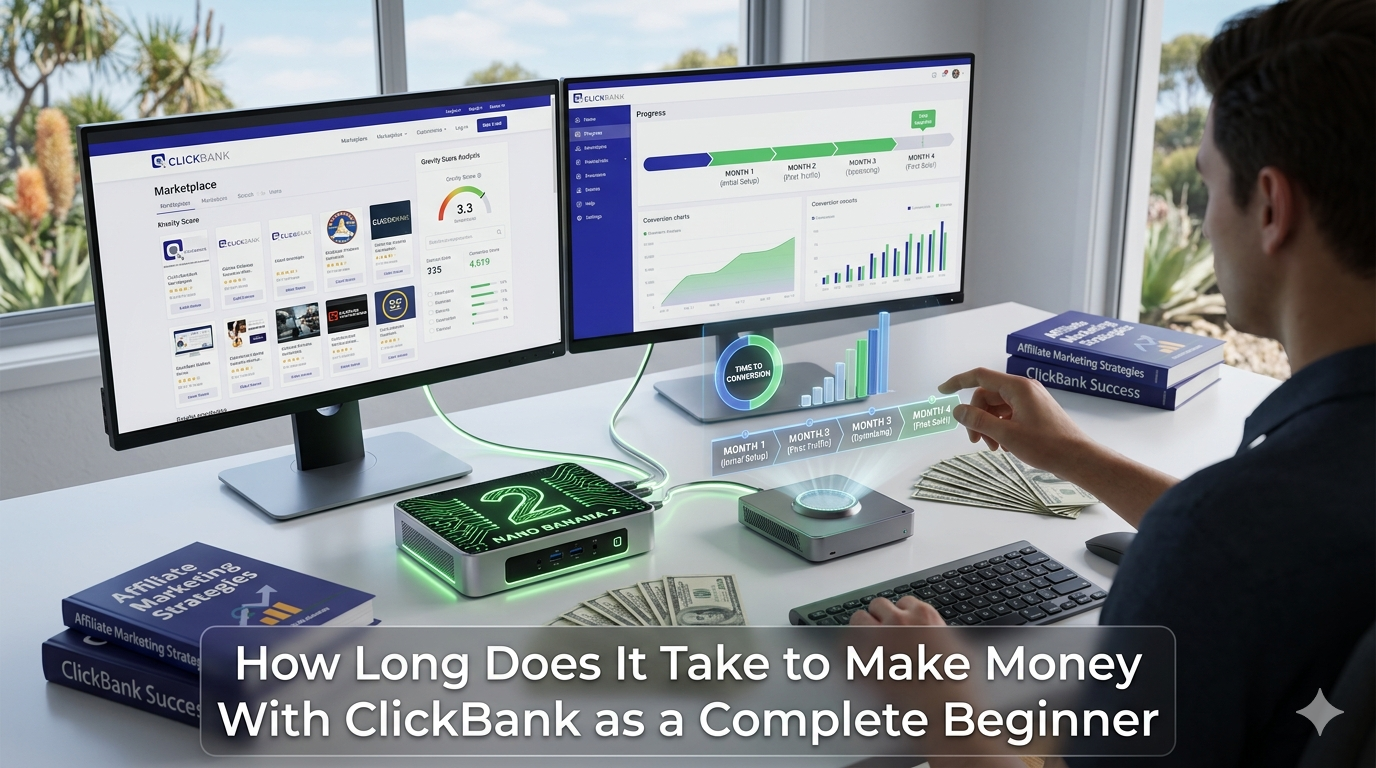
Wondering how long it takes to make money with ClickBank as a complete beginner? Get the honest timeline, the specific factors that speed it up or slow it down, and a realistic month-by-month roadmap for 2026.
Introduction
It’s probably the first question every ClickBank beginner asks, usually within the first 48 hours of discovering the platform: how long until I actually make money from this? And the honest answer they receive is almost always one of two unhelpful extremes. Either something deliberately vague — “it depends on your effort!” which is technically true and practically useless — or something recklessly optimistic, designed to get someone to buy a course or join a system rather than to genuinely prepare them for what the experience actually involves.
Neither answer serves the person asking. The vague answer leaves you with no framework for understanding what’s normal, what’s concerning, and what action might actually change your trajectory. The optimistic answer sets you up for disappointment when your first month doesn’t match the screenshot-driven promises you encountered in the sales funnel that got you interested in ClickBank in the first place.
I want to give you a different kind of answer — specific, honest, and built around the actual variables that determine how quickly someone moves from zero to genuine ClickBank income, rather than motivational generalities dressed up as guidance. I’ve watched the trajectories of numerous ClickBank beginners across different approaches, different products, and different consistency levels. What I’ve consistently found is that the gap between “first commission in two weeks” and “first commission in four months” is almost never about talent, intelligence, or luck. It comes down to a specific, identifiable set of decisions — the system you choose, the sequence you follow, and the consistency you maintain.
By the end of this article, you’ll know the honest timeline across different approaches, a realistic month-by-month roadmap for what genuinely happens when you follow a structured system consistently, the specific factors that speed up or slow down your personal timeline, and the fastest legitimate path available to a beginner in 2026. Let’s get into it.
 Click here to join the ClickBank Profit Club free membership and start your realistic, honest path to ClickBank income today.
Why “How Long Does It Take” Is the Wrong Question to Start With
Before getting into the timeline data, I want to reframe the question itself — because the framing shapes the actions that follow from it, and the standard framing produces passive waiting rather than active building.
“How long does it take to make money with ClickBank?” treats timing as something that happens to you — a fixed duration set by external forces you have no influence over. It positions you as someone waiting for an outcome rather than someone actively constructing one. And the waiting mindset is one of the most expensive patterns in beginner affiliate marketing — waiting until you feel ready before posting your first piece of content, waiting for the perfect product before committing to anything, waiting for some external signal that now is the right time to actually start building.
The better question is specific and actionable: what are the factors that determine how quickly I make money with ClickBank, and which of those factors are within my direct control? This question produces a framework rather than a fixed answer, and frameworks are genuinely useful in a way that fixed timelines never can be, because your specific situation — your chosen product, your traffic method, your consistency, your willingness to follow a proven sequence — determines where within the honest range your actual results land.
The two variables that matter most, more than any others, are the system you choose and the consistency you bring to it. The system determines the minimum possible timeline given optimal behaviour — a system with a clear build order, a conversion mechanism, and a structured sequence has a fundamentally different floor than scattered, unstructured promotional activity, regardless of how much effort you bring to either approach. Consistency determines where you land within the range that your chosen system makes possible — the same system produces dramatically different results for someone who shows up three to four times per week for ninety days versus someone who posts in bursts separated by weeks of silence.
Reframing the question from “how long does it take” to “what determines the timeline and what can I control” shifts you from passive waiting toward active building — and that shift alone is responsible for a meaningful portion of the difference between beginners who reach genuine income and beginners who quit somewhere in month two or three.
The Honest Timeline — What Actually Happens for Different Approaches
Let me give you the honest data across the different approaches a ClickBank beginner might take in 2026 — because the range is genuinely wide, and understanding why it’s wide is more useful than any single average number.
Direct linking with no system — sharing a raw ClickBank hoplink on social media with no capture page, no email list, and no structured follow-up — is the most common beginner approach and also the slowest, least reliable path to genuine income. Cold traffic converting directly on a first encounter happens at rates between 0.5% and 2%, meaning the overwhelming majority of clicks produce nothing, and there’s no mechanism for a second chance with the visitors who don’t convert immediately. Beginners using this approach commonly report their first commission arriving anywhere between four and sixteen weeks after starting — and a meaningful proportion never reach a first commission at all, because the lack of any compounding mechanism means results depend entirely on a continuous stream of fresh cold traffic with no residual value carried forward.
Free traffic with a capture page and email sequence — the asset-first approach covered extensively throughout this series — produces a meaningfully different and more reliable timeline. Beginners following this approach consistently, with the foundational components built before significant traffic investment, typically generate their first commission within two to four weeks, with their list-based follow-up sequence beginning to produce reliable monthly commission income somewhere between weeks six and twelve. The key difference from direct linking is that this approach builds a compounding asset from day one, meaning each week’s traffic effort contributes to a growing system rather than producing only one-off, isolated results.
Paid traffic with developed advertising skills — running profitable Facebook or Google ad campaigns to ClickBank offers — has the theoretical potential to be the fastest path, with some experienced affiliates generating profitable campaigns within days of launching them. For a true beginner without prior paid advertising experience, however, the realistic timeline is complicated by the skill development curve required to run profitable campaigns at all. The typical beginner paid traffic experience involves two to three months of testing, optimising, and often losing money before reaching genuine profitability — meaning the actual time to net positive income, accounting for ad spend, is frequently slower than the free traffic approach for someone starting with zero prior paid advertising experience.
A structured build order system — like the framework taught inside the ClickBank Profit Club — combines the asset-first free traffic approach with explicit sequencing that eliminates the guesswork most beginners spend their first month or two working through independently. Beginners following a structured build order from day one typically compress the foundation-building period that otherwise consumes weeks of trial and error into days, meaning their effective timeline to first commission and to consistent monthly income sits at the faster end of the free traffic range described above, simply because they’re not spending weeks figuring out what to build first.
The honest range across all four approaches, synthesised: first commission somewhere between two weeks (structured system, consistent effort) and four months (direct linking, inconsistent effort), with consistent monthly income that feels genuinely meaningful typically arriving somewhere between month three and month six for beginners who maintain consistent activity following a structured approach.
Month by Month — A Realistic ClickBank Income Roadmap
Concrete is more useful than abstract, so here’s the specific month-by-month trajectory for a beginner following a structured build order with consistent effort.
Month 1: foundation building. This month is about completing the foundational components — product selection using the six-criterion framework, capture page creation, lead magnet development, and the initial email follow-up sequence — alongside beginning consistent free traffic activity on one primary platform. Success in month one looks like a completed system, not commission income. Some beginners do generate their first commission within month one, particularly those who move quickly through the foundation and begin traffic activity within the first one to two weeks. But the meaningful metric for month one is system completion and consistency of activity, not revenue.
Month 2: early traffic and first real commission signals. With the foundation built and traffic activity running for several weeks, month two is typically when the first genuine commission signals appear — either from direct traffic conversions or from the early stages of the email follow-up sequence converting initial subscribers. List size is still modest, typically somewhere between 30 and 100 subscribers for a consistently active beginner, and monthly commission income, if any has arrived, is typically in the $20 to $150 range. This is proof of concept territory, not income replacement territory.
Month 3: the quiet period that tests commitment. This is frequently the month where beginners’ motivation is most tested, because the dramatic initial momentum of building something new has faded, the foundational excitement of month one is behind them, and the results — while genuinely present — don’t yet feel proportional to three months of sustained effort. This is precisely the period where the compounding curve is building invisibly beneath the surface, even though the visible results don’t yet reflect it. Beginners who push through month three without abandoning their consistent activity are the ones who reach the trajectory described below. Beginners who quit during month three almost always do so right before the curve would have started bending visibly upward.
Months 4-6: compounding becomes visible. By this stage, a beginner who has maintained consistent activity has a meaningfully larger list — often 150 to 400 subscribers — a refined email sequence informed by several months of real performance data, and a traffic presence that has built genuine algorithmic and audience momentum on their chosen platform. Monthly commission income during this period commonly reaches $200 to $600, reflecting the combined effect of new monthly traffic and accumulated subscribers progressing through the follow-up sequence and broadcast emails. This is the period where the abstract concept of “compounding income” becomes a tangible, visible reality in the monthly commission totals.
Months 7-12: the trajectory that separates earners from quitters. For beginners who have maintained consistency through the first six months, this period typically shows continued, often accelerating growth — list sizes commonly reaching 500 to 1,500 or more subscribers, monthly commission income frequently reaching $500 to $2,000 or beyond depending on niche, product commission structure, and the specific consistency and quality of ongoing promotional activity. This is also typically the stage where a second ClickBank product or a second traffic platform might reasonably be added to a now-established foundation.
The 5 Factors That Determine Your Personal Timeline
With the honest range and roadmap established, here are the five specific factors that determine where within that range your personal results will land.
Factor 1: the system you choose and its build order. This is the highest-leverage factor and the one most beginners underweight. A system with a clear sequence — product selection, then conversion infrastructure, then traffic — produces structurally faster results than scattered effort applied without a logical order, regardless of how hard you work within either approach. Choosing the right system first sets the realistic floor for your timeline before any other factor comes into play.
Factor 2: consistency of promotional activity. Within any given system, the beginners who show up three to four times per week, every week, for a minimum of ninety days consistently outperform those who post in unpredictable bursts separated by periods of silence. Consistency is the factor most within your direct daily control, and it’s also the factor most commonly abandoned when early results feel slower than hoped for.
Factor 3: product selection quality. A genuinely well-evaluated product — using the six-criterion framework covered earlier in this series — converts traffic more efficiently than a poorly chosen one, meaning the same traffic volume produces meaningfully different commission results depending on the underlying product’s funnel quality, commission structure, and genuine value.
Factor 4: traffic method and platform fit. Choosing a traffic platform that aligns with your existing comfort, your niche’s audience demographics, and your content creation strengths produces faster, more sustainable results than forcing yourself into a platform that doesn’t fit your situation. A beginner comfortable with writing who forces themselves into video-heavy TikTok content typically progresses more slowly than the same beginner building consistent Facebook or written content where their natural strengths apply.
Factor 5: willingness to follow the sequence rather than improvise. Beginners who trust and follow a proven build order — even when their instinct suggests skipping ahead to traffic before the foundation is complete, or adding a second product before the first is established — consistently reach meaningful income faster than beginners who improvise their own sequence based on what feels most urgent or interesting in the moment.
Why Most Beginners Take Longer Than They Should
Beyond the five factors that shape the realistic range, there are specific avoidable delays that push beginners toward the slower end of the timeline unnecessarily — and naming them explicitly often interrupts the pattern before it costs months.
The research loop is the most common delay — finding a system, researching it extensively, finding reviews and counter-reviews, watching dozens of YouTube videos, and two or three weeks later still not having joined anything or started building anything. Research feels productive because it’s active information-gathering, but it produces zero progress toward an actual commission without corresponding action. At some point, additional research has zero marginal value, and the only remaining variable is starting.
The perfectionism trap shows up as waiting to post the first piece of content until it feels exactly right, waiting to launch the email sequence until every email feels polished, waiting to choose a product until you’ve reviewed every option in the marketplace exhaustively. The skills that produce genuinely good content, genuinely effective emails, and genuinely confident product selection are developed through doing, not through endless preparation before doing.
The multi-product mistake — splitting promotional attention across three or four ClickBank products simultaneously rather than focusing deeply on one — dilutes the compounding effect that drives faster results. Each product receives a fraction of the attention it would have received with focused effort, and none of them develops the depth of content and audience association that drives meaningful commission volume.
The skipped foundation mistake — grabbing an affiliate link and starting to drive traffic before the capture page and email sequence exist — produces the slower, less reliable direct-linking timeline described earlier, even when the underlying intention was to eventually build a proper system. Skipping the foundation to “save time” almost always costs more time than building it would have taken.
The inconsistency pattern — intense bursts of activity followed by extended periods of silence — resets the compounding clock repeatedly. Algorithms reward consistent accounts. Audiences build trust through consistent presence. A beginner who posts intensely for two weeks, disappears for a month, and then resumes never accumulates the sustained momentum that drives a faster timeline.
The Fastest Legitimate Path to ClickBank Income
With the factors and avoidable delays established, here’s what the genuinely fastest legitimate path looks like for a beginner starting in 2026 — legitimate meaning it doesn’t rely on manufactured shortcuts, misrepresentation, or unsustainable tactics that produce short-term results at the cost of long-term reputation or income.
A structured build order shortens the timeline more than any single traffic tactic, because it eliminates the weeks most beginners spend independently figuring out what to build first, second, and third through trial and error. The specific sequence that compresses months into weeks looks like this: select your product using the complete six-criterion framework within your first few days rather than weeks of indecision; build your capture page and lead magnet within your first week, using simple, available tools rather than waiting to perfect the design; write your foundational seven-email sequence within your first one to two weeks, in your authentic voice, focused on genuine value before any pitch; and begin consistent traffic activity on one chosen platform from week two onward, maintaining three to four posts per week without interruption.
A beginner following this compressed sequence typically reaches the “month two” position described in the earlier roadmap by the end of their actual second to third week — meaning the foundational delays that commonly consume a beginner’s first month are compressed into the first one to two weeks, accelerating every subsequent stage of the trajectory by a comparable margin.
The ClickBank Profit Club’s free membership accelerates exactly this early-stage compression, by providing the build order framework explicitly from day one rather than leaving a beginner to discover the right sequence independently through the kind of costly trial and error described throughout this series. The free membership doesn’t change the fundamental need for consistent effort over a meaningful timeframe — nothing legitimately does. What it changes is how much of that timeframe gets wasted on figuring out the sequence versus actually executing within a sequence that’s already been clearly established.
What Happens After Your First Commission — The Real Timeline to Consistent Income
First commission is a milestone worth celebrating, but it’s important to understand precisely what it represents and what it doesn’t — because the psychological meaning you assign to it shapes whether you continue building or whether you stall out shortly after reaching it.
First commission is proof, not income. It confirms that your product selection, your conversion system, and your traffic method all function together well enough to produce a real result. It does not represent a repeatable, predictable monthly income stream — that requires continued consistent activity over the following months, building on the proof your first commission provided rather than treating it as a finish line.
The gap between first commission and first consistent month — meaning a month where commission income arrives reliably from a combination of new traffic and accumulated subscriber follow-up rather than from a single isolated sale — is typically two to four months for beginners maintaining consistent activity following a structured system. This gap is where the compounding described throughout the month-by-month roadmap actually accumulates, and it requires the same consistent activity that produced the first commission, sustained rather than relaxed once the initial proof has been achieved.
The compounding trajectory from month one to month twelve, synthesised from everything covered in this article: modest foundation-stage results in months one through three, visible compounding in months four through six, and accelerating, increasingly substantial monthly income in months seven through twelve for beginners who maintained consistent activity throughout. This trajectory is not guaranteed — it reflects what consistent effort within a structured system realistically produces, not a promise independent of the effort and consistency that the rest of this article has emphasised repeatedly.
The patience principle that separates long-term earners from quitters is straightforward to state and genuinely difficult to practice: the months where results feel disproportionately small relative to your effort — typically months two and three — are not evidence that the system doesn’t work. They’re the normal, necessary period during which the compounding foundation is being built beneath results that don’t yet visibly reflect it. Beginners who understand this in advance, rather than discovering it through disappointment, are considerably more likely to maintain the consistency that the later months reward.
Conclusion
How long does it take to make money with ClickBank as a complete beginner? The honest answer: first commission is realistically achievable within two to four weeks for a beginner following a structured build order with consistent free traffic activity, with consistent, meaningful monthly income typically developing somewhere between month three and month six, and substantially accelerating growth commonly visible by months seven through twelve for those who maintain consistency throughout.
The single action that shortens this timeline more than any other is adopting a structured system with a clear build order from day one, rather than spending your first weeks or months independently discovering through trial and error what most beginners eventually learn the hard way — that sequence matters more than any individual tactic, and that the foundation needs to exist before significant traffic effort compounds into anything meaningful.
The ClickBank Profit Club’s free membership provides exactly this structured starting sequence, at zero financial cost, removing the guesswork that otherwise consumes the early months of most beginners’ ClickBank journeys.
Stop asking how long it will take in the abstract. Start asking what you’re going to build in the next seven days. That second question, answered consistently over the following twelve months, determines the answer to the first far more reliably than any timeline estimate ever could.
Where are you at in your ClickBank timeline right now — just starting, stuck in the quiet middle months, or beginning to see the compounding take shape? Drop a comment below. I read every one and respond with honest, specific guidance based on exactly where you’re at.