Introduction
Every single year, millions of people decide they want to start an online business — and almost immediately hit the same wall I did when I first started researching my options. Two models keep coming up over and over again in every forum, every YouTube video, every “make money online” blog post: affiliate marketing and dropshipping. Both are presented as the ultimate beginner-friendly path to financial freedom. Both have passionate advocates swearing they're the best option. And both, frankly, can feel equally overwhelming when you're trying to figure out which one is actually right for you.
I spent an embarrassing amount of time paralyzed by this exact decision. I'd watch a dropshipping success story and get completely fired up — then read about a blogger earning passive income through affiliate commissions and switch gears entirely. I flip-flopped between the two for almost two months before a mentor told me something that cut through all the noise: “Stop comparing them in the abstract and start comparing them to your specific situation.” That advice changed everything.
That's the spirit of this guide. I'm not going to tell you that one model is universally better than the other — because that's not true and anyone who tells you otherwise is oversimplifying. What I am going to do is give you an honest, detailed comparison of both models across every dimension that actually matters to a beginner: startup costs, difficulty, income potential, time investment, risk, and scalability. By the end, you'll have everything you need to make the right call for your specific goals, resources, and personality. Let's dig in.
What Is Affiliate Marketing and How Does It Work?
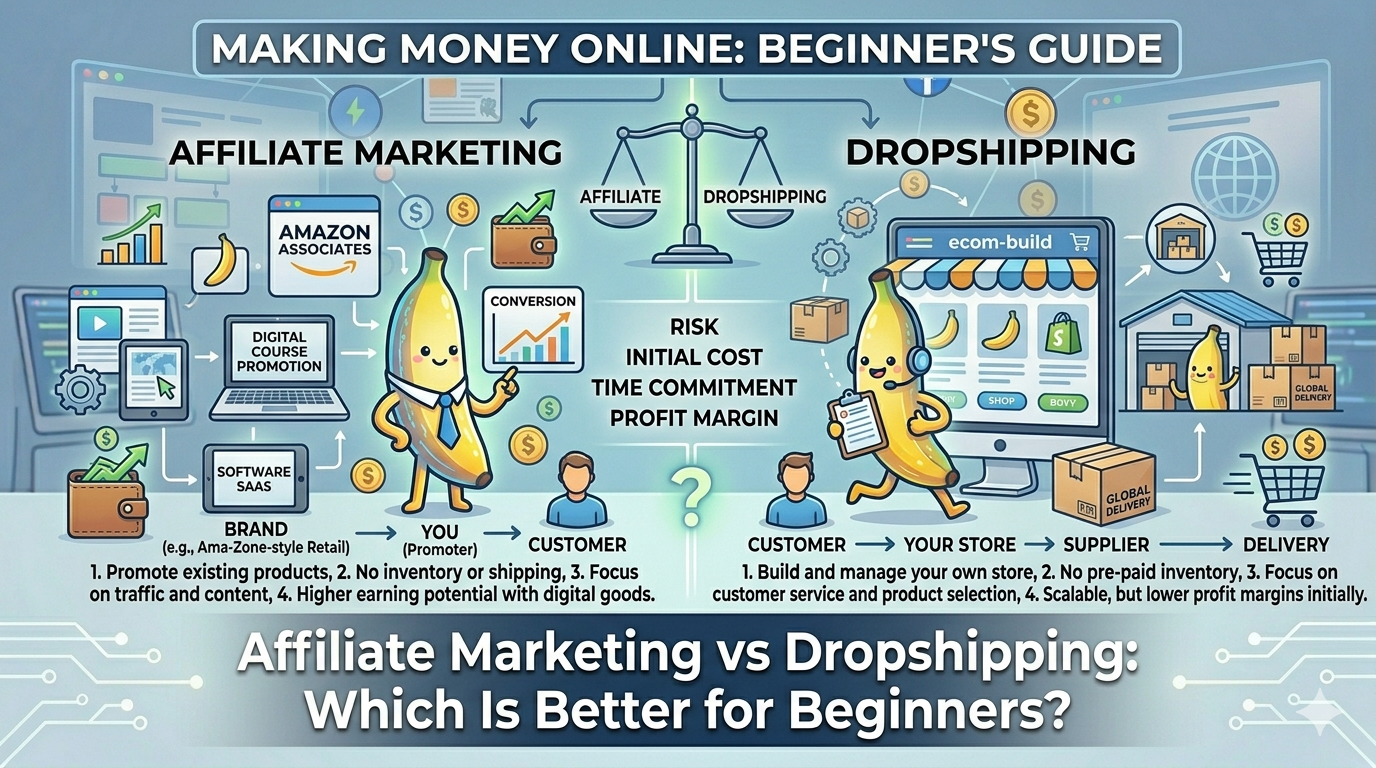
Let's make sure we're working from clear definitions before comparing anything. Affiliate marketing is a performance-based online business model where you earn a commission by promoting someone else's products or services. You don't create the product. You don't handle inventory, shipping, or customer service. Your job is to create content that connects buyers with products, and when a purchase happens through your unique referral link, you get paid a percentage of the sale.
The mechanics are beautifully simple. You join an affiliate program — Amazon Associates, ClickBank, ShareASale, or thousands of others — and receive a unique tracking link for each product you want to promote. You create content around those products — blog posts, YouTube videos, Pinterest pins, email newsletters — and embed your links naturally within that content. When a reader clicks your link and makes a purchase, the sale is tracked back to you via a cookie and your commission is recorded. Payment typically arrives monthly once you clear the program's minimum threshold.
Your role as an affiliate marketer is fundamentally that of a content creator and audience builder. You're in the business of trust — building a relationship with an audience that values your recommendations and acts on them. The better your content, the more targeted your audience, and the more relevant your product recommendations, the more you earn. Affiliate marketing naturally suits people who enjoy writing, creating videos, or building social media content, and who have patience for a model that builds slowly but compounds powerfully over time.
What Is Dropshipping and How Does It Work?
Dropshipping is an e-commerce business model where you sell physical products through your own online store without ever holding inventory yourself. When a customer places an order in your store, you purchase the product from a third-party supplier — typically at a lower price — and the supplier ships it directly to the customer. The difference between what the customer pays you and what you pay the supplier is your profit margin.
The operational flow looks like this: you set up an online store (typically on Shopify), source products from suppliers (commonly through platforms like AliExpress, CJ Dropshipping, or US-based suppliers), list those products in your store at a markup, run advertising to drive traffic to your store, and process orders by forwarding them to your supplier. You're essentially the storefront and marketing operation — the supplier handles the actual product and fulfillment.
Your role as a dropshipper is part e-commerce operator, part marketer, part customer service manager. You're running a real store that real customers visit and buy from — which means you're responsible for the customer experience even though you don't control the fulfillment. Dropshipping naturally suits people who are comfortable with paid advertising, enjoy the product research and store-building side of e-commerce, and don't mind a more operationally active business model with faster potential income but more ongoing management requirements.
Startup Costs — Affiliate Marketing vs Dropshipping
This is one of the starkest differences between the two models and one of the most important factors for beginners evaluating their options. Let me break down the realistic startup costs for each.
For affiliate marketing, the bare minimum startup costs are genuinely minimal. A domain name runs about $15 per year. Basic web hosting costs $3–5 per month. A free WordPress installation, a free lightweight theme, and a handful of free plugins — and you have a fully functional affiliate marketing website for under $75 for the first year. Add in a free email marketing account through ConvertKit or Mailchimp and free keyword research tools like Google Keyword Planner, and you have a complete operational setup for under $100 annually. The primary investment in affiliate marketing is time, not money.
For dropshipping, the startup costs are significantly higher and — critically — include ongoing costs that many beginners don't anticipate when they're calculating their initial investment. A Shopify store starts at around $39 per month. A professional theme might cost $100–$200 upfront. Product research tools like AutoDS or Zik Analytics run $15–$30 per month. And then there's the big one: paid advertising. Dropshipping relies heavily on paid ads — primarily Facebook, Instagram, and TikTok ads — to drive traffic to your store. Testing products with paid ads to find a winner routinely costs $500–$2,000 or more before you find something that converts profitably. Realistic first-year startup costs for dropshipping land somewhere between $2,000 and $5,000 when you factor in advertising spend, tools, and store setup.
The hidden costs in dropshipping that most beginners get blindsided by include payment processing fees (typically 2–3% of each transaction), refund and return costs that often eat directly into thin profit margins, advertising creative production costs, and the cost of dead inventory tests that simply don't convert. These add up fast and can turn what looks like a profitable month on paper into a break-even or losing month in practice.
For beginners with limited budgets — which describes the majority of people starting out — affiliate marketing wins this category decisively. The low cost of entry means the financial risk is minimal and the pressure to generate revenue immediately is far lower.
Difficulty and Learning Curve — Which Is Harder to Start?
Both models have learning curves, but they're different in nature and intensity. Understanding what skills each model requires helps you assess which aligns better with your existing strengths and your willingness to develop new ones.
Affiliate marketing requires proficiency in content creation, SEO, keyword research, and audience building. If you're comfortable writing or creating videos and enjoy the research side of content strategy, the learning curve feels manageable — steep at first but steadily flattening as you build experience. The technical side of setting up a WordPress blog is accessible enough that most beginners figure it out within a weekend. The bigger challenge is learning SEO well enough to get your content ranked and found — a skill that takes months to develop but is entirely learnable from free resources.
Dropshipping requires proficiency in a broader set of operational skills: e-commerce store setup, product research and supplier evaluation, paid advertising (which is a complex and expensive skill to develop), customer service management, and order fulfillment oversight. The paid advertising component is where most beginners hit a genuinely steep wall. Facebook and TikTok advertising requires understanding audience targeting, creative testing, budget optimization, and conversion tracking — skills that take significant time and money to develop and that can cost hundreds or thousands of dollars in failed ad spend during the learning process.
From a purely technical setup perspective, both Shopify and WordPress are beginner-friendly platforms. But the operational complexity of running a dropshipping store — managing suppliers, handling customer complaints, processing returns, monitoring ad performance daily — creates a more demanding ongoing workload than the content creation and SEO focus of affiliate marketing. Most honest assessments of the two models agree that dropshipping has the steeper and more expensive learning curve, particularly around paid advertising. For beginners with no prior marketing or e-commerce experience, affiliate marketing presents a more forgiving learning environment.
Income Potential — Which Makes More Money?
This is the question that gets the most attention and generates the most misleading answers — so let me give you the real picture for both models at every level.
At the beginner level, dropshipping can potentially generate income faster than affiliate marketing — particularly if you find a winning product and have the budget to test ads aggressively. It's not uncommon to hear about dropshippers making their first sale within their first few weeks. However, “making sales” and “making profit” are very different things in dropshipping. Thin margins (typically 15–30% on most dropshipped products), advertising costs, platform fees, and refunds mean that revenue figures are often much more impressive than the actual profit figures underneath them.
Affiliate marketing takes longer to generate first income — typically three to six months for most beginners — but the income that does arrive tends to be higher margin because you have no product costs, no ad spend (if using organic traffic), and no operational expenses to deduct. A $100 affiliate commission is $100 in your pocket. A $100 dropshipping sale might net $15–$25 after costs.
At the intermediate and advanced levels, both models can generate very substantial income. Successful dropshippers running multiple optimized stores with profitable ad campaigns can generate impressive revenue — but maintaining that income requires constant reinvestment in advertising and ongoing operational management. Successful affiliate marketers with established content libraries and diversified traffic sources often earn $5,000–$20,000+ per month with dramatically lower ongoing time investment once the foundation is built.
The income-to-effort ratio over a three to five year horizon tends to favor affiliate marketing significantly — primarily because of the compounding nature of content-based income. An article you wrote two years ago keeps earning commissions today. An ad campaign you ran two years ago has been dead for two years.
Time Investment and Passivity — Which Takes More Work?
Be honest with yourself about how much time you have and what kind of work you actually want to be doing — because these two models make very different demands on your daily schedule.
A dropshipping business is fundamentally an active business. Even with automation tools handling some of the order processing, you're monitoring ad performance daily, responding to customer service inquiries, managing supplier relationships, researching new products, creating ad creative, and handling returns and disputes. During the early scaling phase, dropshipping can easily consume forty or more hours per week — genuinely comparable to a full-time job. As you hire a virtual assistant and build more automation, the time requirement can decrease, but it rarely becomes truly passive in the way affiliate marketing can.
An affiliate marketing business is genuinely more passive in its mature form — but demands significant active investment upfront. In the first year, you're writing content, conducting keyword research, building SEO, and developing your audience. As your content library grows and your rankings establish, the business starts running increasingly on autopilot. Articles rank, traffic arrives, affiliate links get clicked, and commissions accumulate — without you needing to actively manage each sale. Many established affiliate marketers work twenty to thirty hours per week producing new content while their existing library handles a growing stream of passive income in the background.
For someone who values lifestyle flexibility, time freedom, and the ability to step away from the business without it immediately suffering, affiliate marketing has a meaningful structural advantage. The passive income potential of a well-built affiliate site is genuinely real — not instant, not effortless, but real and increasingly hands-off over time.
Risk and Stability — Which Is Safer for Beginners?
Every business model carries risk and neither affiliate marketing nor dropshipping is immune. But the nature and magnitude of the risks differ significantly between the two.
Dropshipping risks are primarily financial and operational. The biggest financial risk is advertising spend that doesn't convert — spending $1,000 testing products and getting nothing back is a common beginner experience. Supplier risks include quality control issues (customers receiving products that don't match the listing), shipping delays especially with overseas suppliers, and suppliers running out of stock without warning. Customer service risks involve managing an experience you don't fully control — if your supplier ships late or sends the wrong item, you bear the reputational consequences. Profit margin compression is another ongoing risk as advertising costs fluctuate and competition drives prices down.
Affiliate marketing risks are primarily platform and algorithm related. A Google algorithm update can impact your search rankings and reduce your traffic — this has happened to many affiliate sites over the years and can be a genuine income shock. Affiliate programs can change their commission rates, alter their terms, or shut down entirely — Amazon Associates famously slashed commission rates in 2020, significantly affecting affiliates who relied heavily on the program. Platform dependency — relying too heavily on any single traffic source or affiliate program — is the main structural risk in affiliate marketing.
Both risks are manageable with the right approach. Diversifying traffic sources and affiliate programs reduces affiliate marketing's platform risk significantly. Rigorous product testing discipline and budget management reduces dropshipping's financial risk. But for beginners with limited capital who cannot absorb significant financial losses during the learning phase, affiliate marketing's risk profile is considerably more forgiving — the worst-case scenario is wasted time rather than wasted money.
Scalability — Which Business Model Grows Better?
Both models are scalable but they scale through fundamentally different mechanisms — and understanding those mechanisms helps you choose the model that aligns with how you want to grow.
Dropshipping scales primarily through paid advertising. You find a winning product, optimize your ad campaigns, and then scale your ad budget to drive more traffic and generate more sales. This can produce rapid revenue growth — going from $1,000 to $10,000 monthly revenue in a matter of weeks is theoretically possible with the right product and optimized ads. The challenge is that scaling ad spend also scales ad risk, and the operational demands of a larger store (more orders, more customer service, more supplier coordination) scale proportionally with revenue. Scaling dropshipping often requires building a team relatively early.
Affiliate marketing scales primarily through content and SEO. You create more content targeting more keywords, build more traffic, and earn more commissions from a growing library of ranking articles. You also scale by diversifying into more affiliate programs, building a larger email list, and expanding into additional content channels like YouTube or Pinterest. This scaling mechanism is slower but more stable — each new piece of content is a permanent asset that keeps generating returns indefinitely, and the operational demands of a larger affiliate site don't scale as steeply as a larger dropshipping operation.
For long-term, sustainable, lifestyle-friendly scaling, affiliate marketing's content-compounding model has a structural advantage. For faster revenue growth with a higher operational ceiling, dropshipping's paid advertising scaling model wins on speed. The question is which type of growth aligns with your goals, risk tolerance, and available resources.
Which Model Is Right for You — Affiliate Marketing or Dropshipping?
Here's the honest framework I use when helping beginners decide between these two models. Answer these questions truthfully and the right choice usually becomes clear.
Choose affiliate marketing if: you have limited startup capital (under $500), you enjoy writing or creating video content, you're comfortable with a slower build in exchange for more passive long-term income, you want a business you can run part-time around existing commitments, you're interested in building a genuine audience and authority in a specific niche, and you prefer lower financial risk even if it means slower initial results.
Choose dropshipping if: you have meaningful startup capital available for advertising ($1,000–$3,000 minimum), you're comfortable with paid advertising or excited to learn it, you want the possibility of faster early revenue even if it comes with higher risk and more active management, you enjoy the product research and e-commerce side of business, and you're comfortable running a more operationally intensive business with customers, suppliers, and daily management demands.
The hybrid approach is worth mentioning because it's something many experienced online entrepreneurs eventually move toward. Building an affiliate marketing blog in the e-commerce or dropshipping niche — creating content that helps aspiring dropshippers with tutorials, tool reviews, and beginner guides — lets you earn affiliate commissions while developing the knowledge base that could support a dropshipping venture later. Some people build the affiliate side first for stable income, then use that income to fund a dropshipping operation. It's a legitimate strategy but requires committing fully to one model first before layering in the second.
How to Get Started With Your Chosen Model Today
If you've decided affiliate marketing is your path, here are your first concrete steps. Choose a niche that combines genuine interest with monetization potential. Register a domain name and set up basic WordPress hosting. Install RankMath for SEO and Pretty Links for affiliate link management. Sign up for Amazon Associates and one or two niche-specific affiliate programs. Conduct keyword research using free tools and build a content calendar targeting low-competition, long-tail queries. Publish your first piece of content this week — not next week, this week. Set up Google Search Console and Analytics immediately. And start your email list from day one even with zero subscribers.
If you've decided dropshipping is your path, your first steps look like this. Set up a Shopify store and choose a clean, conversion-optimized theme. Research your niche and identify potential winning products using tools like AutoDS or manual AliExpress research. Find reliable suppliers and order product samples to verify quality before listing. Set up your product pages with compelling copy and professional images. Create your first ad creative for Facebook or TikTok. Set a strict daily ad budget for testing — $10–$20 per day — and commit to testing systematically rather than impulsively scaling anything that shows early promise. Learn the fundamentals of paid advertising from free YouTube resources before spending a dollar.
In both models, the most common beginner mistake is spreading attention across too many things simultaneously. One niche, one platform, one or two affiliate programs — or one store, one product category, one advertising platform. Master the fundamentals of your chosen model before expanding. The discipline to go deep before going wide is one of the most reliable predictors of early success in either model.
Conclusion
Let's bring everything together. Affiliate marketing offers lower startup costs, lower financial risk, a more forgiving learning curve, better passive income potential, and stronger long-term lifestyle flexibility — at the cost of a slower path to first income and a requirement for patience through a multi-month building phase. Dropshipping offers the potential for faster early revenue, an exciting product-and-store business model, and aggressive scaling potential through paid advertising — at the cost of higher startup investment, steeper operational demands, more financial risk, and an active rather than passive income structure.
If I'm being completely honest about which model I'd recommend to the average beginner with limited capital, limited time, and no prior online business experience — it's affiliate marketing. The lower financial risk, the manageable learning curve, and the genuinely passive long-term income potential make it a more forgiving and ultimately more sustainable starting point for most people. But the right answer for you depends entirely on your specific situation, and I genuinely mean that.
The worst decision you can make is spending another two months going back and forth between the two without committing to either. Pick the model that fits your situation best, commit to it fully for at least twelve months, and give it a real, honest chance before evaluating alternatives. Half-hearted attempts at either model will produce disappointing results — committed, focused execution of either will produce remarkable ones.
Which model are you leaning toward — affiliate marketing or dropshipping? Drop it in the comments and tell me why! I love hearing where people are starting from and I'm always happy to help you figure out the best path forward for your specific situation. Let's get you moving! 