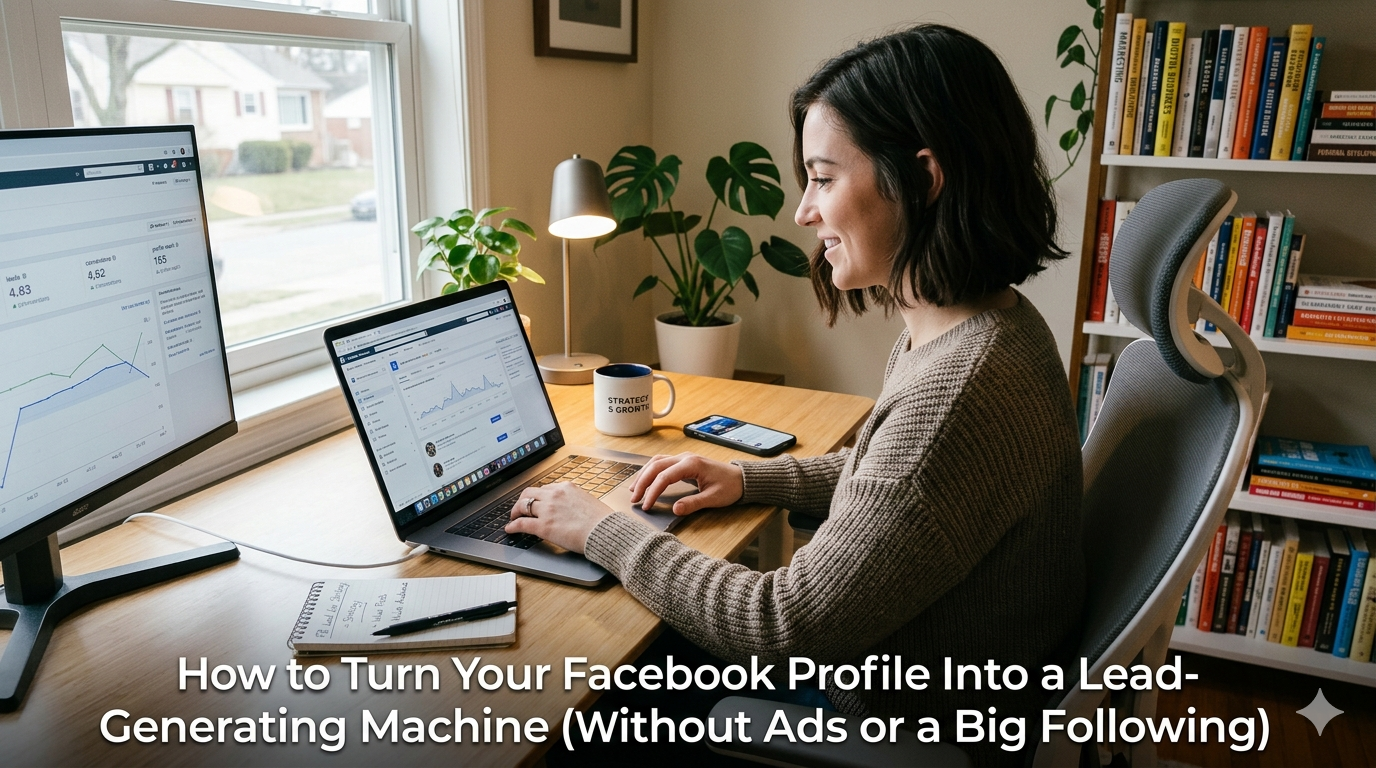
Learn how to turn your Facebook profile into a lead-generating machine without paid ads or a big following. Discover the positioning, content, and conversion system that turns casual visitors into real conversations in 2026.
Introduction
Here’s a sentence I want you to sit with for a second: you’re not failing at Facebook. You’re failing at using it. Those are two very different problems, and the difference matters enormously — because the first one sends you down a rabbit hole of platform-hopping, ad spending, and chasing whatever strategy the loudest person in your Facebook group is swearing by this week. The second one has a specific, fixable cause.
Most business owners have a Facebook profile that was built for socialising, not selling. They post content with no real structure behind it — no system, no sequence, no clear purpose beyond staying visible and hoping something lands eventually. And they measure the wrong things. Likes. Reach. Follower counts. Numbers that feel like progress but have no real relationship to revenue.
Meanwhile, leads are landing on their profile every single week — people who found them through a comment in a group, a share, a friend’s recommendation — and leaving without a word. Not because those people weren’t interested. Because the profile didn’t give them a reason to stay.
That’s the gap this article closes. We’re going to rebuild the way your profile looks in the first ten seconds, what you post and why, the kind of engagement that actually moves the needle, and the five deliberate steps that take someone from total stranger to paying client. None of this requires a large existing audience, an advertising budget, or a decade of marketing experience. It requires the willingness to stop doing things by default and start doing them with intention.
Facebook is still one of the most powerful organic lead-generation tools available to small business owners and solopreneurs in 2026. The people telling you otherwise are usually the ones who never fixed the foundations. Let’s fix yours.
 Click here to access your FREE copy of “Stop Posting Into The Void” and turn your profile into a client-converting machine.
Why Your Facebook Profile Isn’t Generating Leads — It’s Not What You Think
You’ve been showing up. You’ve been posting — maybe not daily, but enough to feel like you’re doing something. Enough to feel like Facebook owes you a result by now. And yet your inbox stays quiet. A like here. A reaction there. Nothing that looks like a real conversation. Nothing that looks like someone raising their hand and saying “I want what you’ve got.”
So you start wondering whether Facebook just doesn’t work anymore. Whether organic reach is dead. Whether you need to switch platforms, start running ads, or chase whatever the algorithm seems to be rewarding this month.
Stop right there. The problem isn’t Facebook. It isn’t even your content, not entirely. The problem is something far more specific — and once you see it, you won’t be able to unsee it.
You’re treating your profile like a diary instead of a business asset. Most people share what they’re feeling, post what they’re thinking, celebrate wins, vent frustrations, share the occasional meme, and — almost reluctantly — mention the thing they actually sell. That’s not a strategy. That’s a social habit. And social habits don’t generate leads.
A Facebook profile built with intention functions like a landing page that breathes. It’s a 24/7 first impression — the place a potential client lands when they Google your name, when a mutual friend recommends you, when they see your comment in a group and think “who is this person?” and click through to find out. What do they find when they get there? If it’s a scrapbook of old holiday photos, vague inspirational quotes, and the occasional business post that reads like it was written under pressure — they find someone who hasn’t made up their mind about what they want to be known for. And people don’t reach out to people who haven’t made up their minds.
There’s a meaningful difference between presence and positioning. Presence just means you show up. Positioning means that when you show up, people understand immediately who you are, who you help, and why they should care. Most people have presence. Almost nobody has positioning.
Positioning answers three questions every visitor is silently asking within their first ten seconds on your profile. What does this person actually do? Not vaguely — specifically, concretely, with enough clarity that a stranger could repeat it to someone else at dinner. Is this person legit? Not famous, just real — evidence of actually doing the thing, evidence of having helped people. Is this person for me? This is the one most people never consider. Your profile should repel the wrong people just as strongly as it attracts the right ones. Try to speak to everyone, and you speak to no one — the people who would actually pay you scroll right past because nothing made them feel personally seen.
When leads aren’t coming in, the instinctive response is to post more. Post daily. Post twice a day. Flood the feed and see what sticks. This is the equivalent of handing out business cards to strangers on the street and wondering why nobody calls. Volume isn’t a substitute for clarity. Posting more to a broken, unclear profile just sends more traffic to a destination that doesn’t convert — more people see the unfocused mess, and more people leave without reaching out, because nothing told them they should.
The uncomfortable truth: people don’t reach out because they’re not sure what they’d be reaching out about. When someone lands on your profile vaguely interested, they want everything to click into place immediately. They want to think “yes, this is exactly the person who can help me with X.” If your profile doesn’t deliver that clarity fast, they don’t message you to ask for more information. They don’t dig through your old posts looking for clues. They just leave, back to the feed, on to the next thing — and you never even knew they were there.
The Ten-Second Test — Fixing Your First Impression
Think about the last time you clicked on someone’s profile because something they said caught your attention — a comment in a group, a post in your feed. What happened in the next ten seconds determined everything. Either you found someone credible and clear, worth knowing more about, and you followed or connected with them — or you found a profile that gave you nothing to hold onto, and you clicked away without a second thought.
That’s the test your own profile is being subjected to dozens of times a week by people you’ll never even know about. First impressions on Facebook are not accidental. They’re either intentional, or they’re working against you. There’s no neutral setting.
Your profile photo has exactly one job: make a stranger feel they’re looking at a real, trustworthy human who takes what they do seriously. Not impressive. Not glamorous. Just real, clear, and professional enough that someone would feel comfortable handing you their money. The most common problems are photos that are too dark or too small to make out a face clearly, group shots where it’s unclear which person is you, logos that hide the human behind the business, or casual snapshots from years ago that send the wrong signal when someone’s deciding whether to trust you. You don’t need a professional photoshoot — though it helps — but you do need good lighting, a clear face, and a background that isn’t distracting. Keep this photo consistent across every platform you use; consistency builds familiarity, and familiarity is the precursor to trust.
Your cover photo is your billboard — the single largest piece of real estate on your profile — and the vast majority of business owners waste it on a sunset, a stock photo, or an old family snapshot. Your cover photo should do at least one of three things, ideally two: tell people exactly what you do in a single clear sentence (“I help tradies get their books sorted without the headache”), provide social proof through a client quote or a result you’ve helped someone achieve, or create an emotional connection by showing you in your element doing the actual work. Free tools like Canva can produce something professional-looking in under twenty minutes — there’s no excuse for leaving this blank.
Your bio is where most profiles quietly die. Click on almost any business owner’s profile and you’ll find either nothing at all, a string of vague emojis and life descriptors, or a copy-paste of a LinkedIn headline from years ago. A strong bio follows one simple structure: who you help, what you help them do, and what they should do next. Compare “Entrepreneur. Coach. Helping people live their best lives ” with “I help burnt-out professionals build consulting businesses that replace their income within 90 days — grab my free roadmap, link below.” One is wallpaper. The other starts a conversation — and critically, it tells the reader exactly what to do next. If you don’t give people a clear next step, they disappear. Always give them one.
The About section and Featured posts are the hidden gold mine almost nobody uses strategically. Your Work and Education section is a chance to restate what you do and link to your website. The Featured section — those pinned boxes near the top of your profile — is where smart business owners showcase a client testimonial, a post that clearly explains who they help, their most engagement-driving content, or a link to a free resource. Treat it like a shop window. Update it regularly, and make sure everything in it serves one goal: turning a visitor into a lead.
Privacy settings are a positioning decision too. If a potential lead visits your profile and your posts are locked and your photos are hidden, they leave with nothing — no evidence you’re real, no window into who you are. You don’t need to broadcast your address, but your business-related insights, client results, and expertise should be visible. Go into your settings and ask, for every category: if a potential client saw this, would it help or hurt my case?
Run the ten-second test on yourself right now. Open your profile on a device where you’re logged out — a friend’s phone works fine. Read your bio. Look at your photos. Scroll your recent posts. Ask honestly: if you knew nothing about this person, would you reach out? Would you trust them with your money? If the answer is anything less than a clear yes, that’s exactly what the rest of this article exists to fix.
What to Post and Why Most People Get It Completely Wrong
Here’s the cycle that traps almost every business owner on Facebook at some point. You decide you’re going to be consistent. You post for a few days. You run out of ideas. You share something random to fill the silence — it gets no engagement, you feel deflated, you go quiet for a week. Guilt creeps in, so you post something desperately promotional that everyone can see through — which also gets no engagement. You end up right back at the start, staring at a blank post box wondering what on earth to say.
The problem isn’t a shortage of interesting things to say. The problem is the absence of a content system. Without one, you’re making a fresh decision every single day, completely at the mercy of your mood, your energy, and the voice in your head insisting nobody wants to hear from you today. That voice is wrong — but it wins when there’s no structure to override it.
Not all content is created equal, and every piece you post should be doing one of four specific jobs.
Authority content establishes you as someone worth listening to — not through bragging or credentialing, but through demonstrating real thinking. The most powerful version is the counterintuitive take: a genuine perspective that runs against conventional wisdom in your space, backed by real experience. “Everyone tells you to niche down as hard as possible — I did the opposite and tripled my revenue. Here’s what actually happened.” This doesn’t need to be long. Four genuine paragraphs with a real point of view will outperform a thousand words of generic advice, because it’s what makes people start thinking “I want to know what this person thinks.”
Connection content is what makes you human — not oversharing, but the behind-the-scenes moment, the honest reflection, the mistake and what it taught you. It matters for lead generation for a strategic reason, not a sentimental one: people buy from people they like, and they like people they feel they know. The golden rule is to share something real and tie it back to something useful. The story is the hook. The lesson is the value. Without the lesson, it’s just a diary entry. Without the story, it’s just advice.
Proof content is your most powerful sales tool and the one most people use least, usually because it feels like showing off. Reframe that. If someone’s silently deciding whether to invest in you, proof content answers the question they haven’t asked out loud: “what actually happens when someone trusts this person with their problem?” Client results, testimonials, transformations, screenshots of wins — share this once or twice a week, made specific, with real context.
Conversion content is the post with a direct call to action — “here’s what I offer, here’s who it’s for, here’s what to do next.” Most business owners either pitch in every post, which trains their audience to ignore them, or never pitch at all, afraid of seeming salesy. The right ratio is roughly one piece of conversion content for every three to four pieces of authority, connection, or proof content. By the time you ask for something, your audience has already been warmed up, educated, and shown evidence — so the ask lands on fertile ground instead of cold resistance.
A Content Calendar You Can Actually Sustain
Forget the elaborate fifteen-column editorial calendars that look impressive in a planning session and get abandoned by Thursday. Here’s a framework simple enough to actually maintain.
Monday — Authority. Share an insight or perspective from your week, made specific, with a real point of view. Wednesday — Connection or Proof, alternating weekly. One week a story that humanises you, the next week a client result. Friday — Conversion or Authority. If you have something to offer right now, Friday is your conversion day; if not, default to another piece of authority content.
That’s three posts a week. Not five, not seven, not “as often as possible.” Three, done with intention, consistently outperforms seven scattered at random — and three is a standard you can actually sustain without it becoming a second job. Most people don’t fail at consistency because they’re lazy. They fail because they set an unsustainable standard, can’t maintain it, and feel like a failure.
The architecture of each individual post matters more than most people realise, because what you say is far less important than how you start saying it. Facebook truncates your post after the first two or three lines, hiding the rest behind “See More.” Your opening line is doing almost all of the work. Great openers do one of three things: create a knowledge gap (“I stopped posting on Facebook for three weeks and my leads actually went up”), make a bold and specific claim (“there are exactly two reasons your profile isn’t generating leads, and neither is your content”), or drop the reader straight into the middle of a story (“I was on a call with a client last week when she said something that genuinely stopped me cold”). Avoid the setup post that spends its first three lines on throat-clearing context before getting anywhere interesting — by then, the reader has already scrolled past.
Once someone clicks “See More,” your job is to deliver on the promise of the opener — be specific, be useful, tell the truth, and close with a clear call to action or a question that invites a response. That engagement signals to the algorithm that your content is worth distributing further, which feeds your next post too.
On timing: Tuesday through Thursday tends to outperform Monday and Friday, and mid-morning or early evening tend to outperform other windows — but content quality dominates timing every time. A great post on a Thursday evening will always beat a mediocre post at the algorithmically “perfect” hour.
The single mistake that undoes everything above is talking at your audience instead of with them. Every post should feel like one side of a genuine conversation, not a broadcast. The test: could a real person say this out loud, over coffee, to a friend? If not, rewrite it until they could.
Stop Chasing Likes — The Engagement That Actually Builds a Pipeline
Be honest — you’ve checked how many likes a post got within the first hour. You’ve felt the small deflation when something you were proud of landed with a quiet thud, and the confused, slightly hollow satisfaction when a throwaway post outperforms everything you deliberately crafted that month.
This is the engagement trap, and it’s costing business owners enormous amounts of time and leads. Likes don’t pay your bills. Engagement is a signal, and like all signals it only means something in context. A post with 200 likes from people who’d never buy from you is worth less than a post with 12 likes that prompts three private messages from genuinely qualified prospects.
Redefine engagement in terms of what it actually means for lead generation. Tier one: comments — not emoji reactions, but substantive comments where someone engages with your thinking or asks a real question. Tier two: shares — an endorsement to someone’s own network, expanding your reach to a cold but pre-qualified audience. Tier three: direct messages — the gold standard, because someone took a friction-heavy step to tell you they’re interested and close to acting.
Your comment section is a sales floor that’s being completely wasted by most business owners. When someone comments something like “this is exactly what I’m struggling with,” responding with a thoughtful, useful answer serves two audiences at once — the commenter, and everyone else reading the thread. And then there’s the move most people miss entirely: when a comment suggests someone might genuinely benefit from working with you, respond publicly and follow up privately. “Sent you a message — got something that might help with what you mentioned.” Warm, natural, not pushy.
A quick warning on engagement pods — groups where business owners agree to like and comment on each other’s posts to game the algorithm. This is one of the most seductive time-wasters in online business. The people reacting aren’t your potential clients; they don’t care about your content, and the algorithm is sophisticated enough to notice engagement that doesn’t convert into real behaviour. Every hour spent in a pod is an hour not spent on genuine content or real conversations.
Two underused features deserve specific attention. Stories sit at the very top of the app — prime real estate most business owners surrender entirely. Use them for behind-the-scenes moments, quick tips, and the informal, real-time side of your business. Five imperfect stories a week build relationship faster than one polished post twice a month. Groups are powerful when you show up as a genuine, generous contributor in spaces where your ideal clients already gather — answering questions, adding perspective, becoming the person who gives the most useful answer every time a relevant topic comes up. People notice your name, click through out of curiosity, and land on the profile you’ve just spent this whole process optimising. That’s not an accident. That’s a funnel.
Instead of checking how many likes your last post got, start tracking: how many meaningful new connections this week, how many comments turned into private conversations, how many of those turned into a call or inquiry, how many of those led to a sale. That’s your actual pipeline.
From Profile Visitor to Paying Client — The 5-Step Conversion System
Your profile is tight. Your content is building authority and trust. Engagement is genuine and growing. People are visiting your profile who weren’t there before. Now what?
This is where the profile becomes a pipeline — where the visitor becomes a conversation, the conversation becomes a prospect, and the prospect becomes a client. Most business owners fumble this stage not because they’re bad at sales, but because there’s no system on the back end. The lead shows up at the door, and nobody’s home.
Step 1: Create an entry point that’s impossible to miss. Every visitor should encounter at least one clear, frictionless invitation to go deeper — a guide, a checklist, a short training, a genuinely useful free resource. This can live in your bio, your Featured section, your cover photo text, or a pinned post. The most effective entry points right now skip forms entirely in favour of a comment trigger (“Comment GUIDE below and I’ll send it over”) or a single-field sign-up. The test: could someone go from visiting your profile to receiving your offer in under two minutes with zero confusion? If not, simplify until they can.
Step 2: Respond faster than your competition. This sounds basic; it’s anything but. Studies on lead response time consistently show conversion odds dropping sharply within the first hour of contact, and falling off a cliff after 24 hours. When someone reaches out, they’re at peak interest right then. Set up notifications, make responding a genuine priority, and aim for a response within a few hours during business time. Treat every incoming message like the lead it is — because it is.
Step 3: Lead the conversation, don’t chase it. The mistake here cuts two ways — either avoiding any mention of your offer and having a meandering chat that goes nowhere, or pivoting to a pitch within three messages and making the other person feel like a transaction. The better arc: be genuinely curious about their situation, ask questions, listen more than you talk, and when you understand enough to know whether you can actually help, offer a conversation rather than a sale. “Based on what you’ve told me, this sounds like exactly the kind of thing I help with — want to jump on a quick call?” Low stakes, far more likely to be accepted.
Step 4: Nurture the people who aren’t ready yet. Not everyone who visits, engages, or even messages you is ready to buy today. Some are still figuring out they have a problem. The mistake is treating anyone who doesn’t book a call immediately as a lost cause. The opportunity is staying visible through consistent content so that when they are ready, you’re the obvious first call. This is the long game, and it’s where most of the money actually lives — the person who’s followed you for six months doesn’t shop around when they finally act; they already know who they want to work with.
Step 5: Ask for the referral before the goodwill goes cold. The moment right after you’ve delivered a result, finished onboarding a client, or had a great discovery call — even one that didn’t convert — is when someone’s goodwill toward you is at its peak. That’s the moment to ask. Not transactionally, but specifically and humanly: “the people I tend to help most are [describe your ideal client] — if anyone comes to mind, I’d love an introduction.” Most people genuinely want to help; they’re just waiting to be asked. And a referral from someone who trusts you arrives pre-warmed in a way no cold lead ever does.
Why Most People Never See Results — And the System That Fixes It
Here’s the full picture, zoomed out. Your profile is the asset. Your content is the engine. Your engagement is the warm-up. Your conversations are the conversion. None of these work in isolation. A great profile with no content generates nothing. Great content on a badly optimised profile loses half its audience before they finish reading the bio. Content without real conversations is just entertainment. Conversations with no clear next step are just networking.
Most people never experience Facebook as a genuine lead source not because it doesn’t work, but because they’re running one or two pieces of this system while leaving the rest completely unaddressed. When the profile, the content, the engagement, and the conversion steps are all working together — that’s when the inbox actually changes. The names coming through stop being random faces from your past and start being people who found you because of what you wrote, who followed you because of what you stood for, and who reached out because everything they saw told them you were exactly who they’d been looking for.
That’s not magic. That’s a system — and systems, unlike inspiration, show up every single day whether you feel like it or not.
Conclusion
You started this article wondering whether Facebook still works. It does. What doesn’t work is a profile with no positioning, content with no system, engagement chased for the wrong reasons, and zero plan for what happens after someone actually shows interest.
Now you know the difference between a profile that exists and one that works. You know why first impressions either open doors or quietly close them. You know the four content types that build a real pipeline, and why posting more without strategy is just noise at a higher volume. You know that likes were never the goal — conversations are. And you know the five steps that take a stranger from scrolling past your profile to sitting across from you on a call, already half-convinced before you’ve said a word.
That’s not a small thing. Most business owners spend years on Facebook without ever connecting these dots.
But information without implementation is just entertainment. The system only works if you build it. Pick one thing from this article — fix the bio, rewrite the cover photo text, write your first authority post with a real point of view — and do it today.
When you’re ready for the complete system, the templates, and the full walkthrough, it’s waiting for you.
What’s the first thing you’re going to fix on your profile — the photo, the bio, or your next post? Drop a comment below. I read every one. 