Introduction
Every single month, millions of people type some version of “how to make money online” into Google. Millions. And buried inside that massive wave of searches is a growing number of people who’ve heard the term “affiliate marketing” thrown around — on podcasts, in YouTube videos, in that one Facebook group they joined last year — and want to finally understand what it actually means and how it actually works. If that’s you, welcome. You’re in exactly the right place.
I remember the first time I tried to figure out affiliate marketing. I spent an entire Saturday afternoon watching YouTube videos and reading blog posts and by the end of it I understood less than when I started. Everything was either too vague — “just share links and earn money!” — or too technical, drowning me in jargon before I’d even grasped the basics. What I needed was someone to sit down with me and walk through the whole thing step by step, like explaining it to a smart friend who just hadn’t encountered it before.
That’s exactly what this guide is. No jargon. No hype. No skipping the parts that actually matter. I’m going to walk you through the complete affiliate marketing process from start to finish — every step, in order, with real context for why each one matters. By the time you finish reading this, you’ll have a clear mental map of exactly how affiliate marketing works and what you need to do to get started. Let’s get into it.
 Click here to get your MegaLink for $7 — and learn affiliate marketing step-by-step in 2026.
What Is Affiliate Marketing and Why Does It Work?
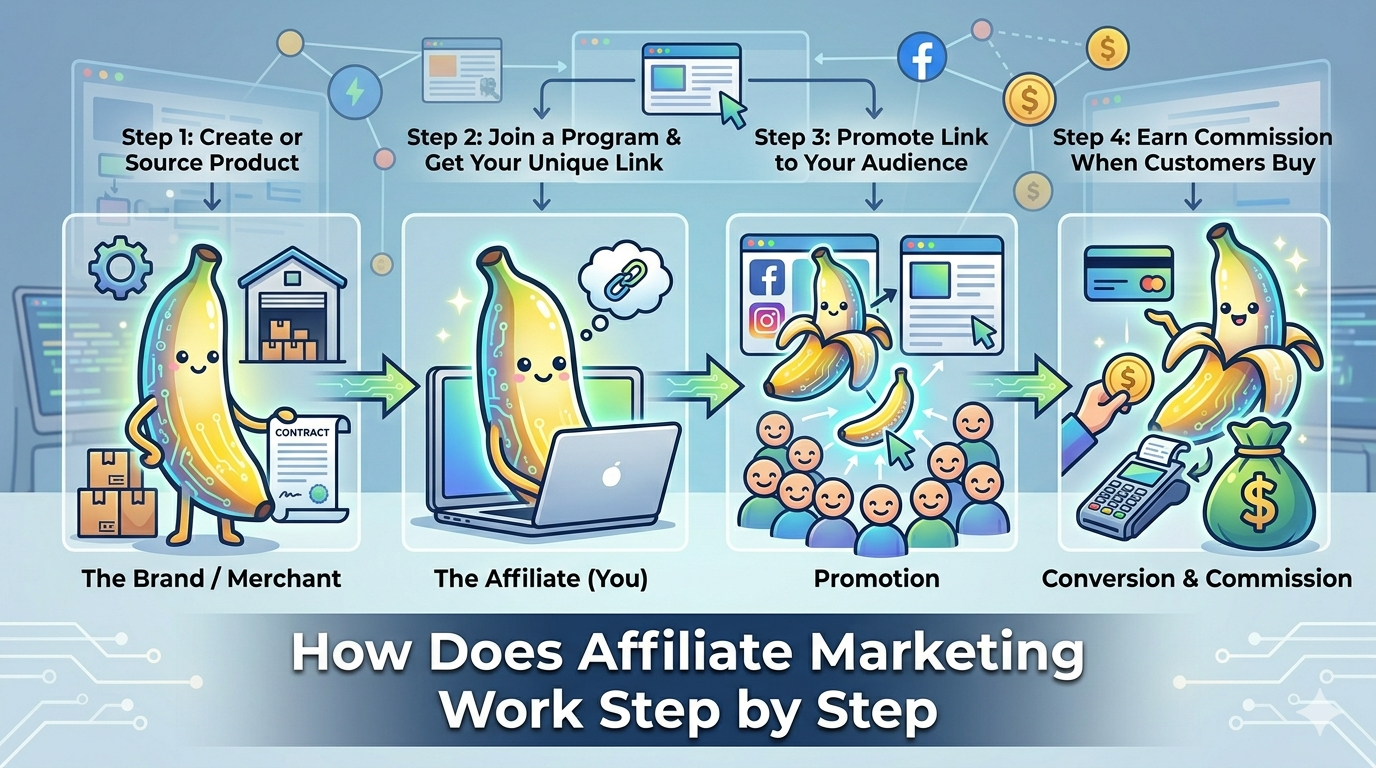
Before we dive into the steps, let’s make sure we’re working from the same simple definition. Affiliate marketing is a performance-based business model where you earn a commission by promoting someone else’s product or service. When someone buys through your unique referral link, you get paid. That’s the whole thing. Recommend, refer, earn.
The reason this model works so beautifully — for everyone involved — is that it aligns incentives perfectly. The merchant only pays when a sale actually happens, so there’s no wasted marketing spend. The affiliate earns money by doing what good content creators do naturally: recommending useful things to their audience. And the consumer gets helpful, experience-based recommendations that make their buying decision easier. Everybody wins when it’s done right.
For beginners, affiliate marketing has a genuinely compelling set of advantages over other online business models. There’s no product to create, no inventory to manage, no shipping to coordinate, and no customer service to handle. Your job is to create content, attract an audience, and connect that audience with products that solve their problems. It’s one of the lowest-barrier, highest-potential online income models available in 2026 — and the step-by-step process is more straightforward than most people realize.
Step 1 — Choose a Niche
Every successful affiliate marketing business starts here, and no amount of great content or clever marketing can compensate for getting this step wrong. Your niche is the specific topic area your content will focus on — and choosing the right one is the foundation everything else is built upon.
A good affiliate niche sits at the intersection of three things: something you’re genuinely interested in, an audience that’s actively searching for information, and products or services you can earn commissions promoting. All three elements need to be present. Interest without an audience means no traffic. An audience without monetization means no income. And monetization without genuine interest means you’ll burn out before you ever see real results.
To validate a niche for free, start by searching your topic on Google and observing the autocomplete suggestions — these represent real searches real people are making. Check whether affiliate programs exist in the space by browsing ShareASale or ClickBank. Look at Amazon to confirm there are products being actively sold. If Google is returning rich results and affiliate programs exist, money is flowing through that niche. Beginner-friendly niches with strong affiliate potential include personal finance, home office and remote work, pet care, fitness, parenting, and personal development.
The most expensive niche mistake beginners make is choosing based purely on commission rates rather than genuine interest. When results are slow — and they will be slow at first — your authentic curiosity about the topic is what keeps you creating content. Pick something you can write about enthusiastically for the next two to three years and the monetization will follow.
Step 2 — Build Your Platform
Once you have your niche, you need somewhere to publish your content — a platform where your audience can find you and where your affiliate links live. This is your home base on the internet, and building it correctly from the beginning saves enormous headaches later.
For most beginners, a self-hosted WordPress blog is the strongest starting point for long-term affiliate marketing success. It gives you full control over your content, your design, and your monetization. You’re not subject to platform rules that could restrict affiliate links or shut down your account. Basic WordPress hosting costs around $3–5 per month and a domain name runs about $15 per year — genuinely one of the lowest startup costs of any real business. Pair that with a lightweight theme like Astra or GeneratePress and a few essential plugins like RankMath for SEO and Pretty Links for affiliate link management, and you’ve got a professional setup ready to go.
If budget is a real constraint, free platforms like Blogger, WordPress.com, or Medium can get you started. YouTube is another powerful free option — particularly for building trust quickly through video. Pinterest and TikTok work brilliantly as supplementary traffic platforms alongside your main content hub. The key principle regardless of which platform you choose is this: pick one primary home for your content and commit to building it consistently before spreading yourself across multiple channels.
Step 3 — Find and Join Affiliate Programs
With your platform taking shape, it’s time to find products to promote and get your unique affiliate links. This step is more straightforward than most beginners expect — and remember, joining affiliate programs is always completely free.
There are two main ways to access affiliate programs. Affiliate networks are marketplace platforms that connect you with hundreds or thousands of merchants in one place. The biggest and most beginner-friendly networks include Amazon Associates, ShareASale, ClickBank, CJ Affiliate, and Impact. You apply to the network once and then apply to individual merchant programs within it. Direct affiliate programs are run by companies independently of any network — often with higher commission rates because there’s no middleman taking a cut. Many software companies, course creators, and premium brands run their own programs this way.
When evaluating any affiliate program before joining, look at four key things: the commission rate, the cookie duration, the payment schedule and minimum payout, and the quality of the products themselves. A 30% commission with a 60-day cookie is dramatically more valuable than a 3% commission with a 24-hour cookie — even if the product prices are similar. And always, always promote products you’d genuinely recommend to a friend. Your audience’s trust is worth infinitely more than any single commission check.
Once approved to a program, you’ll access your unique affiliate links through the program’s dashboard. These links contain a tracking code that identifies you as the referring affiliate. Copy those links carefully — they’re how you get credited for every sale you generate.
Step 4 — Create Content Around Your Affiliate Products
Here’s where the real work begins — and where most of the long-term value of your affiliate business gets built. Content is the engine that powers everything else in this model. Without helpful, well-crafted content, you have no traffic, no audience, and no commissions.
The content formats that work best for affiliate marketing are product reviews, comparison posts, how-to tutorials, and best-of listicles. Product reviews work brilliantly for capturing people who are close to a buying decision and need that final nudge. Comparison posts — “Product A vs Product B” style articles — target people in active research mode who are weighing their options. How-to tutorials teach a process and naturally introduce affiliate products as recommended tools within the workflow. Listicles like “10 Best Tools for X” attract a broad audience and can promote multiple affiliate products within a single piece of content.
When incorporating affiliate links into your content, the goal is to make them feel completely natural — a helpful resource rather than a sales push. Don’t dump all your links in the first paragraph or plaster them every other sentence. A well-placed link early in the post, a few throughout the body where they’re genuinely relevant, and a clear call to action near the end tends to convert well without feeling pushy or desperate. Always add an FTC disclosure at the top of any content containing affiliate links — it’s legally required and it actually builds trust with readers who appreciate the transparency.
Consistency matters enormously. Two well-researched, genuinely helpful pieces of content per week beats one rushed post every day. Build a simple content calendar, stick to it, and watch your content library grow into a compounding traffic and income asset over time.
Step 5 — Drive Traffic to Your Content
Great content sitting in the dark earns exactly zero dollars. Getting people to actually read your content is what bridges the gap between effort and income — and there are multiple effective strategies for doing this, many of them completely free.
SEO — search engine optimization — is the highest-leverage long-term traffic strategy available to affiliate marketers. By targeting specific keywords your audience is searching for and optimizing your content to rank in Google’s results, you attract a steady stream of targeted visitors who want exactly what you’re writing about — and you pay nothing for those clicks. The catch is patience: meaningful SEO traffic typically takes three to six months to build for a new site. But once it arrives, it compounds. Content you write today can be generating traffic and commissions years from now.
Pinterest deserves serious attention as a free traffic source, particularly for lifestyle, home, finance, and health niches. Unlike most social platforms where content disappears within hours, a Pinterest pin can drive traffic for months or years. It functions more like a search engine than a social network — people use it actively looking for ideas and solutions, which means they’re in exactly the right mindset to click through and read your content. Create keyword-rich pins using free Canva templates and post consistently for compounding results.
Email marketing is the traffic channel most beginners underestimate and most experienced affiliates swear by. Unlike social media or search, your email list belongs entirely to you — no algorithm can hide your content from subscribers who’ve chosen to hear from you. Start building your list from day one using a free tool like ConvertKit or Mailchimp, offer a simple lead magnet in exchange for sign-ups, and use your list to drive traffic to new content and affiliate promotions consistently.
Step 6 — Convert Visitors Into Buyers
Getting traffic to your content is one thing. Turning those visitors into people who click your affiliate links and make purchases is another — and this is where a lot of beginners leave significant money on the table without realizing it.
Conversion in affiliate marketing starts with trust. Readers who trust your recommendations click your links and buy. Readers who sense you’re just trying to make a commission click away. The fastest way to build trust is to be relentlessly honest — share genuine pros and cons, admit when a product isn’t right for everyone, and only promote things you’d actually recommend to someone you care about. That authenticity is palpable and it’s your most powerful conversion tool.
Strategic link placement significantly impacts your click-through rates. Include your primary affiliate link early in the content for readers who don’t make it to the end. Weave links naturally throughout the body where they add genuine value. Place a clear, compelling call to action near the conclusion. Using a button or visually distinct link rather than plain hyperlinked text can also boost clicks — readers notice them more easily when scanning.
Your calls to action should be specific and helpful rather than generic. “Click here to check the current price” or “See why thousands of beginners use this tool” outperforms a bland “buy now” link every time. Give the reader a reason to click that’s about them and their needs, not about your commission.
Step 7 — Track Your Results and Optimize
This is the step that separates affiliates who plateau from those who grow consistently — and it’s one that way too many beginners skip because it feels less exciting than creating content. Tracking your results and using that data to improve is what turns a guessing game into a real, scalable business.
Google Search Console is your free starting point for understanding how your content is performing in search. It shows you which keywords you’re ranking for, how many impressions and clicks you’re getting, and which pages are your top performers. Check it weekly and look for patterns — which content is driving traffic, which keywords you’re ranking just outside the top ten for (these are your quickest optimization wins), and whether your click-through rates are healthy.
Google Analytics 4 complements Search Console by showing you what happens after visitors arrive. How long are they staying? Which pages lead to the most affiliate link clicks? Where are people dropping off? This behavioral data tells you where your content is working and where it needs improvement. Both tools are completely free and setting them up takes under an hour — there’s genuinely no excuse for skipping this step.
Beyond these free tools, track your affiliate dashboard metrics regularly. Total clicks, conversion rate, earnings per click, and which specific pieces of content are generating the most commissions — all of this data tells you where to focus your next round of content creation. Double down on what’s working, improve what’s underperforming, and cut what’s consistently delivering nothing. That optimization loop, applied consistently, is how affiliate income grows.
How Does the Affiliate Payment Process Work?
Understanding how you actually get paid is important both for setting expectations and for choosing the right programs to promote. Let me walk you through the mechanics clearly.
When someone clicks your affiliate link, a tracking cookie gets stored in their browser. This cookie contains your unique affiliate ID and has a set expiration window — the cookie duration — which varies by program. Amazon Associates uses a 24-hour cookie. Many other programs offer 30, 60, or even 90-day windows. If the visitor completes a purchase within that window, the sale gets attributed to you and your commission is recorded in the program’s system.
Most affiliate programs pay on a monthly basis with a minimum payout threshold — often $50 or $100. Once your accumulated commissions clear that threshold, payment is issued via bank transfer, PayPal, or check depending on the program. Some programs have a holding period of 30–60 days after the sale before releasing payment, to account for potential refunds. So your first commission in January might not hit your account until March — totally normal, just something to be aware of when managing expectations.
The most beginner-friendly payment model is Pay Per Sale — you earn a percentage of the sale price for every purchase made through your link. Pay Per Lead programs pay you when someone takes a specific action like signing up for a free trial, even without purchasing — these convert more easily. Recurring commission programs — where you earn monthly as long as a referred customer stays subscribed — are the most powerful for building compounding passive income over time. Most seasoned affiliates include at least one strong recurring commission program in their portfolio.
How to Scale Your Affiliate Marketing Step by Step
Once your affiliate business is generating consistent income — even modest income — the question shifts from “how do I start?” to “how do I grow?” Scaling affiliate marketing is about doing more of what works, smarter and more efficiently.
The first and most straightforward scaling strategy is expanding your content library. More high-quality, well-optimized content targeting more relevant keywords means more organic traffic, more affiliate link clicks, and more commissions. Every new piece of content you publish is a new asset that can generate income independently. Set a sustainable publishing schedule and increase it gradually as your systems and skills improve.
Diversifying your affiliate programs and income streams is another critical scaling move. Relying on a single affiliate program is risky — programs change their terms, cut commission rates, or shut down entirely. Building a portfolio of programs across different networks and commission models creates resilience. If one program reduces your earnings, others keep the income flowing while you adjust.
As your monthly income grows, reinvesting strategically accelerates your trajectory dramatically. Your first $100 in commissions could buy a domain and hosting upgrade. Your first $500 month could fund a keyword research tool subscription. Your first $1,000 month could cover a part-time content writer to help scale production. Each reinvestment compounds your earning potential and reduces the bottleneck of doing everything yourself.
The ultimate scaling milestone for most serious affiliate marketers is building a small team — a writer or two, perhaps a virtual assistant for administrative tasks, maybe an SEO specialist. At this stage your role shifts from creator to strategist. You focus on identifying opportunities, managing direction, and optimizing the business while your team executes the content production. That’s when affiliate marketing truly becomes the passive income model it’s often marketed as — but getting there requires putting in the active, unglamorous work first.
Click here to get your MegaLink for $7 — and learn affiliate marketing step-by-step in 2026.
Conclusion
There you have it — the complete, step-by-step breakdown of exactly how affiliate marketing works. Let’s recap the journey we’ve covered together. You start by choosing a niche that combines your genuine interest with real audience demand and monetization potential. You build a platform — ideally a self-hosted blog — as your content home base. You find and join relevant affiliate programs and get your unique tracking links. You create helpful, honest content that naturally incorporates those links. You drive traffic through SEO, Pinterest, email, and social media. You optimize your content to convert visitors into buyers. You track your results and use data to improve continuously. And eventually, you scale what’s working into a growing, diversified income stream.
The process isn’t complicated — but it does require patience, consistency, and a genuine commitment to helping your audience rather than just chasing commissions. Every successful affiliate marketer you’ve ever heard of started exactly where you are right now: at step one, with more questions than answers and more uncertainty than confidence. The difference between those who made it and those who didn’t almost always comes down to one thing — they kept going.
So here’s my challenge to you. Don’t finish this article and move on to the next one. Take one concrete action today. Pick your niche. Set up your free platform. Sign up for one affiliate program. Write your first outline. Do something that moves you from reading about affiliate marketing to actually doing it. One step is all it takes to begin.
Click here to get your MegaLink for $7 — and learn affiliate marketing step-by-step in 2026.
What’s your biggest question about the affiliate marketing process? Drop it in the comments below and let’s work through it together. Every expert was once a beginner — and I’m genuinely here to help you shorten the learning curve! 